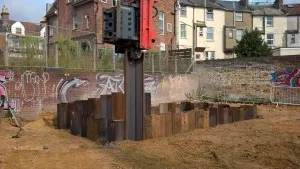
Interlocking steel retention for ground and water control
Sheet piling uses interlocking steel sections installed into the ground to create a continuous retaining barrier. The system can provide structural earth retention while also restricting the movement of water through the retained line.
Sheet piles can be incorporated into temporary or permanent works and are particularly useful for excavations, waterfront structures, cofferdams and boundary retention. Their modular construction allows retaining walls to be formed efficiently along both straightforward and more complex layouts. The most appropriate sheet section and installation method will depend on retained height, ground conditions, groundwater, neighbouring structures and the level of vibration or noise that can be accommodated on site.
Continuous Barrier
Interlocking steel sections form the wall
Water Applications
Suitable for marine and waterfront environments
Flexible Use
Temporary or permanent applications
Efficient Installation
Rapid wall construction where conditions allow
How Sheet Piling Works
Steel sheet piles are installed sequentially along the retaining line, with the interlocks of adjacent sheets connecting to form a continuous wall. Installation equipment and methodology are selected around the soil profile, required embedment, surrounding structures and environmental constraints.
Once installed, the sheet pile wall can retain soil, control excavations and restrict water movement. Depending on the project, the sheets may remain as permanent works or be extracted following completion of temporary construction activities.
- Continuous retaining barrier
- Suitable for soil and water retention
- Fast installation
- Temporary and permanent applications
- Robust steel construction
Best Suited For
Waterfront Works
Marine retaining applications
Cofferdams
Temporary water-excluding structures
Excavations
Efficient temporary or permanent retention
Flood Protection
Water-control applications
Boundaries
Continuous earth-retaining walls
Temporary Works
Potential for extraction after use
Need practical advice before you enquire?
Speak to the team for quick guidance on your piling or foundation challenge.
The Process
A clear route from initial enquiry through to quotation and project delivery
Share site details
Tell us about your site constraints & project objectives
Review service options
We compare suitable methods to outline pros & cons, as well as other considerations
Receive expert advice
Get our expert guidance on buildability, programme fit and access.
Move to quotation
We confirm next steps to support smooth delivery throughout the project’s duration
Related Projects
See more of our work
Explore all of our completed projects across various sectors
Frequently Asked Questions
Are sheet piles watertight?
Their interlocks can significantly reduce water movement, although required watertightness depends on the design and specification.
Does sheet piling create vibration?
Some installation methods do. Site sensitivity needs to be considered when selecting the installation technique.
Can sheet piles be removed?
Temporary sheet piles can potentially be extracted after use, subject to the ground conditions, wall design and construction sequence.
Can sheet piling be used close to existing structures?
Potentially, although proximity to neighbouring buildings, vibration sensitivity and ground conditions need to be considered carefully. The installation method should be selected around the constraints of the surrounding site.